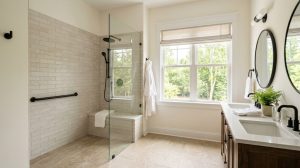

What you need to know now about bathroom renovation Raleigh, NC:
- A full bathroom renovation in Raleigh typically runs $20,000 to $65,000 depending on scope, materials, and whether you’re moving plumbing
- The most expensive part is almost always labor for tile work, plumbing, and waterproofing. Fixtures themselves are a smaller share.
- A $10,000 budget can deliver a meaningful refresh, but a full gut renovation of a primary bathroom generally starts around $30,000 in this market
- Porcelain tile and large-format floor tile dominate in 2026 Raleigh renovations for durability and resale appeal
Read on to understand exactly where the money goes, what different budgets actually buy you, and how to avoid the mistakes that push projects over budget.
Costs shown are general estimates based on national and regional averages, not a quote. Pricing varies by project scope, materials, labor rates, and site conditions. Use these to frame your budget thinking, then get a real number from a contractor.
How Much Does It Cost to Renovate a Bathroom in North Carolina?
A bathroom renovation in North Carolina costs between $10,000 and $60,000 for most homeowners, with the typical full remodel landing in the $20,000 to $65,000 range. In Raleigh specifically, labor rates sit slightly above the state average due to demand in the Triangle market.
A basic refresh (new vanity, fixtures, and paint) can stay under $12,000. A full gut renovation with custom tile, a walk-in shower, and new plumbing typically starts at around $30,000 and climbs from there.
Costs shown are general estimates based on national and regional averages, not a quote. Pricing varies by project scope, materials, labor rates, and site conditions. Use these to frame your budget thinking, then get a real number from a contractor.
Not sure what your project will run? Use the BoCo Modern bathroom renovation cost calculator to get a ballpark estimate based on your scope before you talk to anyone.
Why Does Raleigh Cost More Than the State Average?
Labor is the dominant variable. Triangle-area skilled tile setters, licensed plumbers, and finish carpenters are in demand.
A few other cost drivers specific to Raleigh and surrounding communities like Durham, Cary, Chapel Hill, and Apex:
- Existing layout: Moving a toilet or shower drain requires opening the floor and rerouting supply lines. That adds $2,000 to $5,000 to any project.
- Water damage discovery: Older homes in Wake Forest, Knightdale, and Clayton sometimes reveal rotted subfloor or mold behind existing tile once demolition starts. Budget 10 to 15% as a contingency fund.
- Permit requirements: Wake County requires permits for plumbing and electrical work. A reputable contractor handles this; an unlicensed one won’t.
- Ceiling height and access: Bathrooms with difficult access (second floor, no crawl space access) increase labor time on plumbing work.
How Do Raleigh Project Types Compare on Cost?
| Project Type | Typical Range | What’s Included |
|---|---|---|
| Cosmetic refresh | $6,000 – $12,000 | Vanity, fixtures, paint, mirror, lighting (no tile or plumbing work) |
| Partial remodel | $12,000 – $20,000 | New tile, tub/shower surround, toilet, vanity (existing layout stays) |
| Full gut renovation | $20,000 – $65,000 | Everything new: tile, shower, plumbing fixtures, electrical, ventilation |
| Primary bathroom expansion | $35,000 – $65,000+ | Layout reconfiguration, walk-in shower, double vanity, heated floor |
If you’re looking at a full renovation and want to understand what’s included before committing to a design process, the BoCo Modern bathroom services page walks through exactly what a full remodel covers.
What Does a $10,000 Bathroom Remodel Look Like?
A $10,000 bathroom remodel gets you a solid cosmetic renovation: new vanity, updated fixtures, fresh tile accents, and a modernized feel. It does not cover a full gut renovation in the Raleigh market. At this budget, you’re refreshing, not rebuilding.
Here’s what $10,000 can realistically buy in 2026:
What Can $10,000 Actually Buy in Raleigh?
- New vanity and countertop: Budget $1,200 to $2,500 for a quality freestanding or semi-custom vanity with quartz or solid surface top
- New toilet: $350 to $800 for a comfort-height, water-efficient model
- Lighting update: $400 to $900 for new sconces and overhead fixture
- Mirror and accessories: $300 to $600
- Fresh floor tile (small bathroom): $1,500 to $3,000 installed for a 50 sq ft floor
- Painted walls, new trim: $600 to $1,200
- Labor and installation: $3,000 to $5,000 depending on scope
The math gets tight fast. A $10,000 budget works well for a powder room, a smaller guest bath, or a cosmetic refresh where you’re keeping the shower surround intact.
What Won’t $10,000 Cover?
- Full shower tile replacement (wall and floor tile in a standard shower runs $4,000 to $9,000 installed)
- Any plumbing relocation
- Subfloor repairs or water damage remediation
- Custom or semi-custom built-ins
If your goal is a walk-in shower, a frameless glass door, and large-format floor tile throughout, you’re looking at $20,000 minimum.
What Is a Realistic Budget for a Bathroom Renovation?
A realistic budget for a bathroom renovation depends on scope, but most full renovations in the Raleigh area fall between $20,000 and $65,000 for a standard 5×8 to 8×10 foot bathroom. Primary suites with double vanities, walk-in showers, and upgraded tile routinely land between $30,000 and $55,000.
The biggest budget mistake homeowners make is underestimating labor, which often accounts for 40 to 50 percent of the total project cost.
How Do Budget Ranges Break Down by Scope?
Is a Refresh Budget Right for You? ($8,000 to $14,000)
Right for you if:
- You’re keeping the existing shower and tub in place
- The tile is in decent condition or you’re doing partial updates
- You want modern fixtures and a cleaner look without a full demo
Typical scope: New vanity, toilet, lighting, mirror, paint, possibly LVP flooring on top of existing subfloor.
When Does a Full Remodel Make Sense? ($20,000 to $65,000)
Right for you if:
- You want everything new: tile, shower, plumbing fixtures, vanity, lighting
- The existing layout is staying the same
- You’re renovating a standard-size bathroom (5×7 to 8×10 ft)
This is the most common scope for homeowners in Cary, Apex, Garner, and Fuquay-Varina who bought homes built between 2000 and 2015 and are finally addressing original builder-grade finishes.
What Does a Primary or Custom Renovation Include? ($35,000 to $65,000+)
Right for you if:
- You’re reconfiguring the layout
- You want a walk-in steam shower, heated floors, or custom cabinetry
- You’re doing a primary bathroom in a higher-value home
- You’re in a neighborhood like North Hills, Brier Creek, or similar where finishes need to match the home’s market position
Wondering how long the project will take once you’re ready to move forward? The BoCo Modern bathroom remodel timeline guide breaks down the full process from design to final walkthrough.
What Is the Most Expensive Part of a Bathroom Renovation?
Labor for tile work, plumbing, and waterproofing is consistently the most expensive part of a bathroom renovation. Materials tend to get the attention in planning conversations, but in practice, installation drives the majority of the budget.
A $400 tile can cost $2,500 per room to install properly when you account for substrate prep, waterproofing, setting, grouting, and sealing.
Where Does the Money Actually Go?
Typical allocation for a $35,000 full bathroom renovation in Raleigh:
- Tile labor and materials (floor + shower): 30 to 40% of budget
- Plumbing fixtures and rough work: 15 to 20%
- Vanity and countertop: 10 to 15%
- Glass enclosure (if applicable): 8 to 12%
- Lighting and electrical: 5 to 8%
- Drywall, waterproofing, subfloor prep: 5 to 10%
- Permits, cleanup, miscellaneous: 3 to 5%
The takeaway: your tile choice matters far less than your tile installer’s skill level. Cheap tile installed perfectly will outlast expensive tile installed poorly. Grout failures, lippage, and water intrusion behind the shower wall are almost always installation problems, not material problems.
What Hidden Costs Show Up After Demo Starts?
Most bathroom renovation budgets run over not because of design choices, but because of what gets discovered after the walls open:
- Galvanized supply pipes that need replacing (common in Raleigh homes built before 1985)
- Inadequate ventilation that’s been causing moisture damage inside the wall cavity
- Mold behind the original tub surround
- Out-of-level or out-of-plumb framing that requires shimming before tile work can begin
A design-build contractor prices these contingencies into the initial scope. A lower-bid contractor often doesn’t, and you find out at invoice time.
| Cost Surprise | Typical Add-On Cost | Who Usually Finds It |
|---|---|---|
| Subfloor rot beneath tub/shower | $800 – $2,500 | Demolition crew, Day 1 |
| Mold behind tile on exterior wall | $1,200 – $4,000 | After tile removal |
| Out-of-code electrical (no GFCI) | $400 – $900 | Electrical inspection |
| Galvanized supply pipes | $1,500 – $3,500 | Plumber during rough-in |
| Insufficient ventilation | $600 – $1,500 | Framing inspection |
What to Avoid When Renovating a Bathroom?
The mistakes that cost homeowners the most money in bathroom renovations are about process: skipping waterproofing, moving plumbing unnecessarily, choosing materials that don’t work in humid environments, or hiring based on price alone. These decisions compound quickly in a room where moisture is constant.
Why Is Waterproofing the One Thing You Cannot Shortcut?
Waterproofing is invisible when it’s done right. When it’s done wrong, you find out two to five years later when tile starts popping off the wall, or when you spot water stains on the ceiling of the room below.
The right approach uses a sheet membrane or liquid-applied waterproofing behind all wet-area tile. This is not optional. It’s also not visible in a finished bathroom, which is why budget contractors omit it or use the minimum.
When Does Moving Plumbing Actually Make Sense?
Moving a toilet or shower drain to a new location means cutting into the floor, rerouting drain lines, and possibly rerouting supply. This adds $2,000 to $5,000+ to any project. Sometimes it’s necessary. More often, homeowners think they want a layout change during design, then realize the existing layout actually functions fine.
Before committing to any plumbing relocation, confirm it serves a real functional purpose. Many layout changes that seem important during design turn out to be unnecessary once the homeowner thinks through daily use.
Does Large-Format Tile Work in a Small Bathroom?
Large-format tile (24×24 and above) is striking in the right space. In a 5×7 bathroom with a toilet, vanity, and a tub-shower combo, it’s often the wrong call. Installers have to cut more tile, waste increases, and the proportions can make the room feel smaller. A 12×24 or hexagon mosaic typically reads better in tight spaces.
Why Does Ventilation Matter More Than Most People Think?
Raleigh has hot, humid summers. Bathrooms without proper exhaust ventilation accumulate moisture faster than almost any other climate in the Southeast.
The right exhaust fan is sized to the room (at least 1 CFM per square foot), vented directly to the exterior, and on a timer or humidity sensor. Skipping this creates a mold problem behind walls within a few years.
What Happens If You Change Your Tile Selection Mid-Project?
Tile is the decision homeowners most often regret changing mid-project. Switching tile after demo has started can delay a project two to four weeks if the new material is on backorder. Nail down every tile selection before demolition begins.
Raleigh homeowners have strong opinions about tile. The most popular styles right now are large-format porcelain in warm whites and greiges, terrazzo-look floors, and textured wall tiles in a matte finish. See what’s trending locally in our bathroom tile ideas guide for Raleigh homeowners.
What Flooring Is Best for a Bathroom?
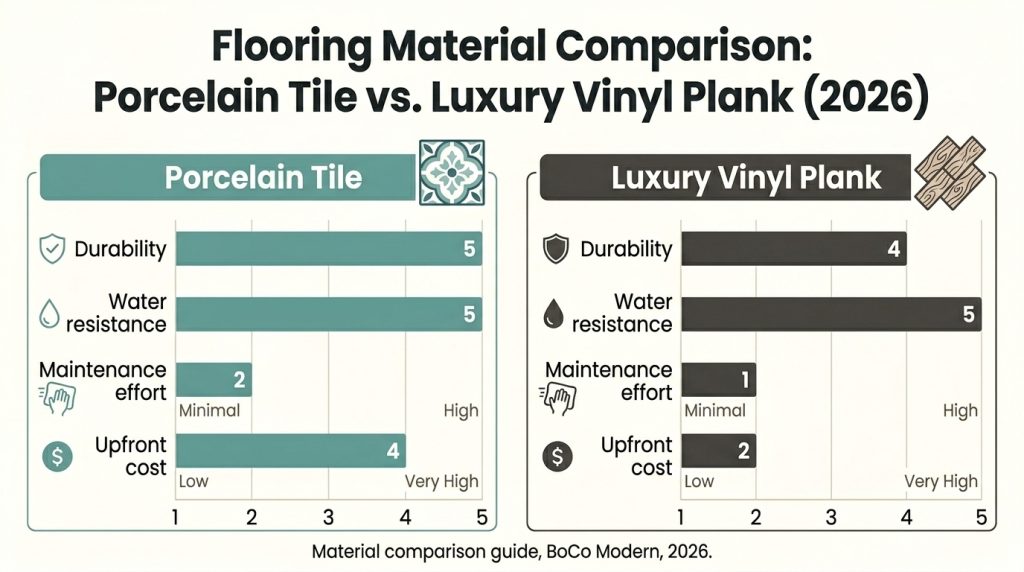
Porcelain tile is the most durable and highest-performing bathroom floor material for most renovations in Raleigh. It handles moisture, humidity, and heat better than any other option, and it holds up to decades of use without significant maintenance.
Luxury vinyl plank (LVP) is a close second: fully waterproof, warmer underfoot, and better for tighter budgets. Avoid natural stone if low maintenance matters; avoid hardwood entirely in full bathrooms.
Is Porcelain Tile Worth the Higher Install Cost?
The default choice for a reason. Fully vitrified, essentially impervious to water when properly installed and grouted.
Advantages:
- Rated for high-moisture environments
- Scratch-resistant and durable under daily use
- Compatible with in-floor radiant heating
- Range of formats: from mosaic to 48×48 large-format slabs
- Adds measurable resale value
Trade-offs:
- Cold underfoot without radiant heat
- Grout lines require periodic sealing and cleaning
- Higher labor cost than LVP due to setting and grouting
When Is Luxury Vinyl Plank the Right Call?
100% waterproof when properly installed with appropriate underlayment. Warmer and softer underfoot than tile.
Advantages:
- Waterproof core with no moisture absorption
- Easier and faster to install, lower labor cost
- Warmer and softer than tile
- Wide visual range (wood-look, stone-look, cement-look)
Trade-offs:
- Scratch and dent resistance varies significantly by wear layer thickness (look for 12 mil or above)
- Cannot be used with in-floor radiant heating in most cases
- Some products off-gas VOCs; look for FloorScore or GREENGUARD Gold certification
Is Natural Stone a Smart Choice for a Family Bathroom?
Beautiful. Expensive. Demanding to maintain. In a primary bathroom where a homeowner is committed to sealing twice a year, it’s a strong choice. In a family bath with kids, it’s usually the wrong one.
Stone requires sealing on installation and annually after that. Unsealed travertine or marble in a wet shower floor is a grout failure and staining problem within two years.
What Makes a Bathroom Look Expensive?
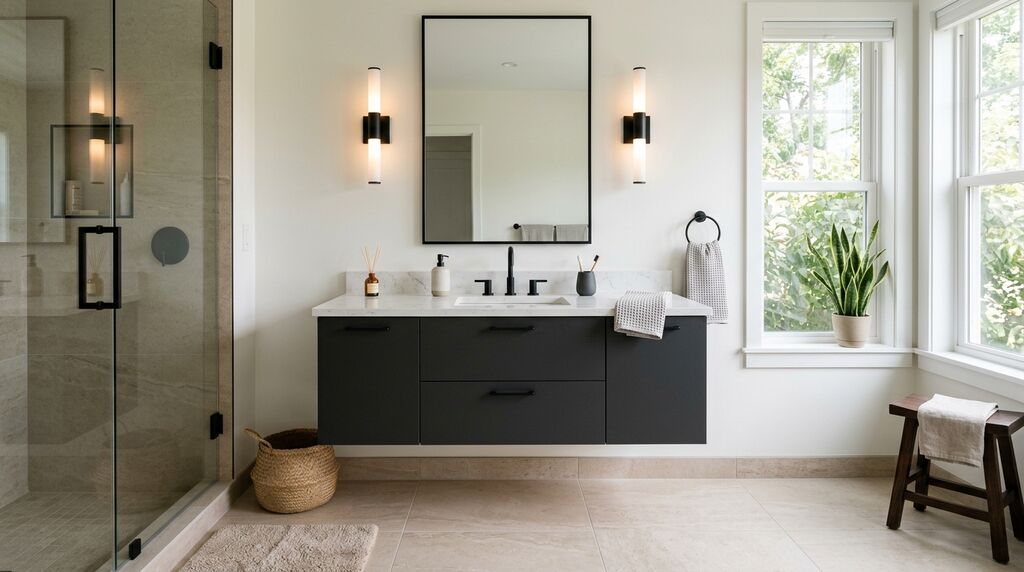
The bathrooms that feel expensive almost never have the highest-cost materials. They have material consistency, intentional contrast, and the absence of visual clutter.
A bathroom with a $4,000 vanity surrounded by mismatched hardware and builder-grade lighting will look cheaper than a bathroom with a $1,400 vanity where every finish was chosen deliberately.
How Much Does Matching Your Hardware Finishes Actually Matter?
Pick one metal finish and commit. Brushed nickel everywhere, or matte black everywhere, or unlacquered brass everywhere. The moment you have two metal tones in the same bathroom (chrome faucet, brushed nickel towel bar, brass mirror frame), the space reads as unresolved.
This is free. It costs zero additional dollars. It makes an enormous difference.
Does a Frameless Shower Enclosure Really Make That Big a Difference?
A frameless shower door or a walk-in shower with no door at all instantly reads as a higher-end renovation than a framed aluminum threshold. A semi-frameless enclosure is a reasonable middle ground.
Budget: $800 to $2,500 for a semi-frameless; $2,000 to $5,000 for full frameless.
Why Do Larger Tiles With Tight Grout Lines Look More Expensive?
Larger tile format with a pressed grout joint (1/16″ to 1/8″) makes any shower look more expansive and more finished than smaller tile with wide, visible grout lines. This is partly a perception effect and partly that large-format tile signals custom craftsmanship.
What Lighting Setup Makes a Bathroom Feel More Upscale?
Most bathrooms have one overhead fixture and nothing else. Expensive-feeling bathrooms have:
- Vertical sconces flanking the mirror (eliminates under-eye shadow)
- An overhead recessed light or flush fixture
- Possibly an accent light in a niche or under a floating vanity
All three together cost $600 to $1,400. The difference in how the bathroom reads is significant.
Why Does a Floating Vanity Make a Bathroom Feel Bigger?
A vanity mounted to the wall rather than resting on the floor visually lifts the space, makes the room appear larger, and reads as custom even when it’s not. It also makes cleaning the floor dramatically easier.
Want a Full Renovation Without the Design Waiting Game?
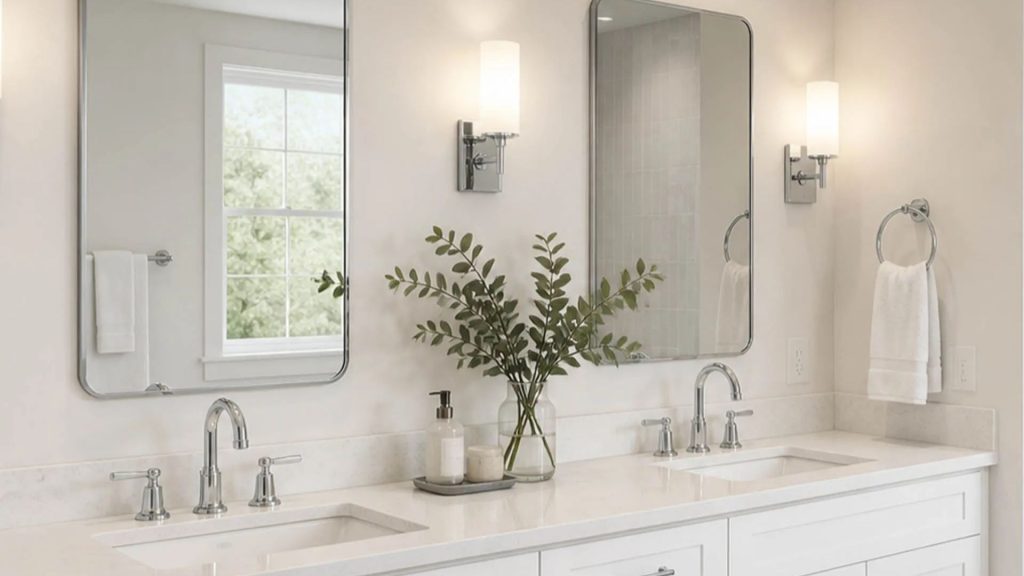
Most bathroom renovations in Raleigh take longer than homeowners expect. The build itself is rarely the bottleneck. Choosing tile, vanity, countertop, fixtures, lighting, and hardware that all work together takes weeks when you are doing it from scratch.
BoCo Select Bathrooms is a different approach.
Each BoCo Select package is a fully coordinated bathroom design, curated by BoCo Modern’s in-house design team. The vanity, countertops, shower tile, floor tile, lighting, and plumbing fixtures are already selected to work together. These are not random finish boards or entry-level options; they are materials the team uses on custom projects and keeps in stock.
Here’s what makes it different:
- Defined investment from day one. Every package shows a starting-at price built around a standardized reference bathroom, so you can compare directly. After a site review, you receive a complete written proposal: total investment, what’s included, and schedule.
- Faster to build. Custom design-build projects can stretch six months or more. BoCo Select is built to move faster: less disruption, same craftsmanship.
- A full remodel. Every BoCo Select bathroom includes full demolition of the existing bathroom, all-new materials, and BoCo Modern’s standard of workmanship. Nothing is reused.
You choose the package. The team handles everything else.
Ready to see what a BoCo Select bathroom looks like for your home? Explore BoCo Select Bathroom packages and get a real price without a drawn-out design process.
Frequently Asked Questions About Bathroom Renovations in Raleigh, NC
Do I need a permit for a bathroom remodel in Wake County?
Yes, for most full renovations. Wake County requires permits for plumbing work (moving or adding fixtures), electrical work (new circuits, panel changes), and structural changes. Cosmetic work (new tile on existing backer board, a new vanity that uses existing supply connections) typically doesn’t require a permit. A licensed contractor will pull the required permits and schedule inspections. If a contractor tells you permits aren’t necessary for a scope that clearly involves plumbing or electrical, that’s a warning sign.
What adds the most value to a bathroom renovation for resale?
Midrange renovations consistently outperform high-end ones at resale. According to Fixr’s analysis of the 2025 Cost vs. Value Report, a midrange bathroom remodel nationwide returned 80% of its cost at resale in 2025, the highest return since 2007. For Raleigh homeowners, focusing on a complete, clean renovation with quality tile, an updated vanity, and efficient fixtures consistently outperforms spending the same money on luxury upgrades.
Can a design-build contractor handle permits, design, and construction?
Yes, and that’s the specific advantage of the design-build model. A design-build firm manages design, permitting, subcontractor coordination, and construction under one contract. There’s no gap between what was designed and what gets built, and there’s a single point of accountability if something needs to be addressed.
How far in advance should I book a bathroom renovation in the Raleigh area?
Quality remodeling contractors in Raleigh, Cary, Durham, and surrounding communities are currently booked four to eight weeks out for project starts. The planning and design phase (selecting finishes, confirming scope, pulling permits) typically takes two to four weeks before construction begins. Starting conversations now generally means you can be in construction within six to ten weeks.
Does BoCo Modern serve areas outside of Raleigh?
Yes. BoCo Modern handles bathroom renovations throughout the Triangle, including Durham, Chapel Hill, Cary, Apex, Holly Springs, Garner, Fuquay-Varina, Wake Forest, Knightdale, and Clayton.
Why Do Raleigh Homeowners Choose BoCo Modern for Bathroom Renovations?
Bathroom renovation is the most requested remodeling project in the country. According to NAHB’s Q4 2025 survey published by Eye on Housing, 73% of professional remodelers rated bathroom remodeling as common to very common in their business. That is a crowded field, and it means the range of contractor quality in any given market is wide.
BoCo Modern is a design-build firm. That means design and construction are managed by the same team, under one contract, with one point of contact. There’s no moment where a contractor shows up and says “the design firm told us something different.” What gets drawn is what gets built.
The team works across Raleigh, Durham, Chapel Hill, and the broader Triangle, working with communities that have specific permit requirements, soil conditions, and housing stock the team knows well. For homeowners in Garner, Wake Forest, Knightdale, and Clayton, that local knowledge matters when unexpected conditions arise during demolition.
If you’re weighing a full custom design build against a faster, more defined scope, the BoCo Select Bathrooms program gives you a third option: a complete, professionally designed renovation without the extended selection process.
BoCo Modern works across Raleigh, Durham, Chapel Hill, Cary, Apex, Holly Springs, Garner, Fuquay-Varina, Wake Forest, Knightdale, and Clayton. See the full list of service areas to confirm your neighborhood is covered.
Start with a conversation. Contact BoCo Modern to talk through your bathroom, your goals, and what a realistic scope looks like for your home.