What You Need to Know Now About ADU Cost
- ADU cost in the Triangle typically runs from $65,000 for a garage conversion to $380,000 or more for a detached unit, depending on size, foundation work, and finish level.
- Type drives price more than anything else. Garage conversions, attached additions, and detached cottages each carry different structural requirements and timelines.
- Raleigh caps most ADUs at 800 to 1,000 square feet, requires no extra parking, and runs a Fast Track permitting program many homeowners never hear about.
- Lenders increasingly let projected or actual ADU rental income count toward mortgage qualification, which changes what a lot of homeowners can actually afford to build.
Keep reading and you will know exactly what to budget, what Raleigh’s rules really require, and how to avoid the surprise costs that blow up ADU budgets.
What Is an ADU, and Why Are So Many Triangle Homeowners Building One?
An ADU, or accessory dwelling unit, is a smaller, self-contained living space built on the same lot as your main home. It has its own kitchen, bathroom, and entrance. Triangle homeowners build them to house aging parents, adult kids, remote workers, or paying tenants, all without moving.
The reasons we hear most often:
- Housing a parent nearby without sacrificing anyone’s privacy
- Creating rental income that offsets a mortgage payment
- Giving an adult child a place to land during a transition
- Adding a dedicated home office or studio away from the main house
We hear all four regularly across Raleigh, Durham, and Cary.
Multigenerational living is not really a trend anymore. It is just how a lot of Triangle families live now.
How Much Does an ADU Cost in 2026?
ADU cost in 2026 ranges from $65,000 for a basic garage conversion to $380,000 or more for a detached, ground-up unit. Most Triangle homeowners land between $150,000 and $260,000. Size, foundation type, and finish level drive most of that spread.
For context, new custom home construction nationally priced out at a $166 per square foot median in 2024, the most recent year with finalized data.
ADUs routinely cost more per square foot than a full-size house, not less. A kitchen and bathroom eat up a bigger share of a small footprint than they do in a 2,500 square foot home.
Garage Conversion
Converting an existing two-car garage into a livable unit is the cheapest path into ADU territory. You already have a slab, walls, and a roof.
Expect $65,000 to $140,000 in the Triangle, depending on whether you add a full kitchen and bath or just a kitchenette and half bath.
Attached ADU
An attached ADU shares a wall with your main house, which usually means shorter utility runs and a simpler permit path.
Budget $130,000 to $250,000. The final number depends heavily on whether you are building over an existing footprint or extending the foundation.
Detached ADU
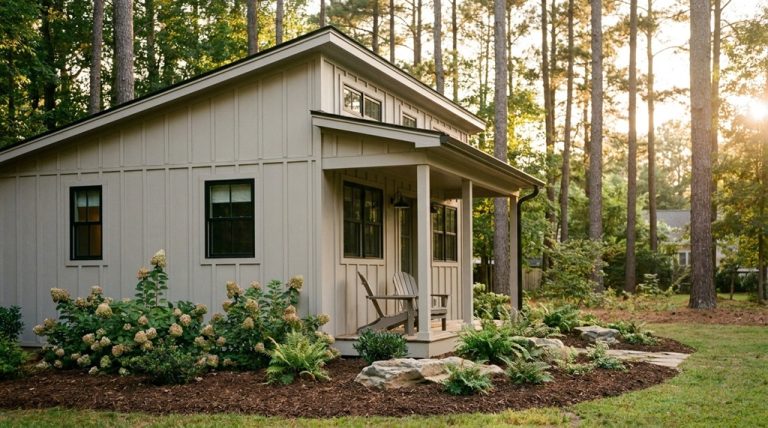
A detached unit is essentially a small, separate house on your property. It needs its own foundation, roof, and full utility connections.
Plan for $190,000 to $380,000, more if your lot has slope, tree removal, or a long utility run from the street.
| ADU Type | Typical Size | Foundation Needed | Utility Connection | Best For |
|---|---|---|---|---|
| Garage Conversion | 400-500 sq ft | Existing slab, reinforced if needed | Usually already stubbed nearby | Fastest budget option |
| Attached ADU | 500-700 sq ft | Extended from existing foundation | Shared trench, shorter run | Aging parents, caregivers |
| Detached ADU | 600-1,000 sq ft | New independent foundation | Full new trench and hookups | Rental income, maximum privacy |
How Much Does an ADU Cost in Raleigh, Durham, and Cary Specifically?
Most Triangle ADU projects land between $150,000 and $260,000 all-in, and Raleigh, Durham, and Cary sit close to each other on price since labor and material costs barely shift across the metro. Permit timelines are the bigger local difference, not cost.
In our own projects across Raleigh, Durham, and Cary, the biggest swing comes from lot conditions, not city limits.
A flat lot with existing sewer and electrical capacity costs far less to build on than a sloped lot on well and septic.
Want a number for your specific lot? Get a free, no-obligation estimate from the BoCo Modern team. Use Our Free Project Calculator →
What Drives ADU Costs Up or Down?
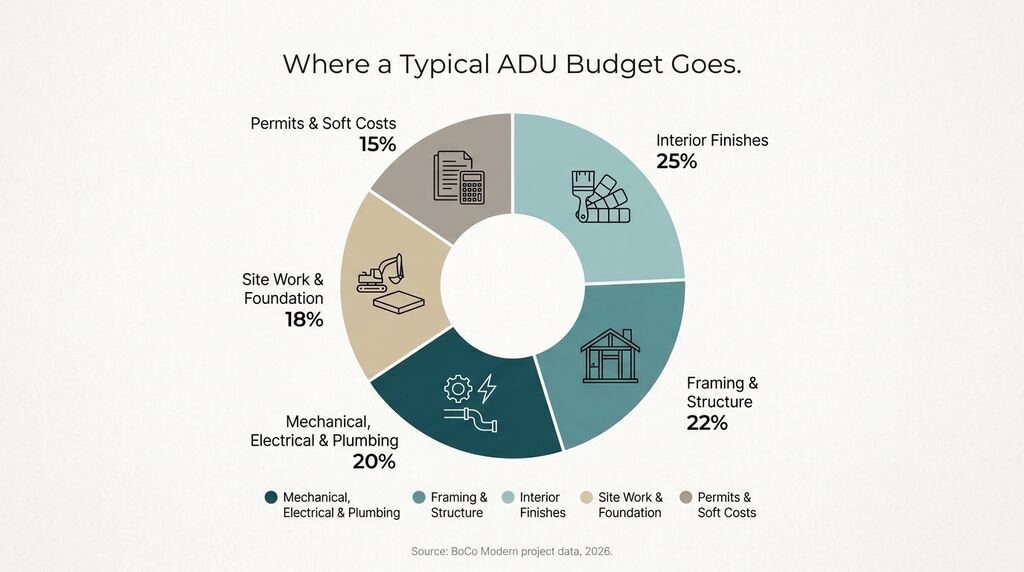
Site conditions, contract structure, and finish level move an ADU budget more than anything else. Soft costs like permits, design fees, and utility hookups typically add 15 to 25 percent on top of raw construction. A fixed-price, design-build contract protects you from the open-ended overruns that plague ADU projects nationally.
The line items that move a number the most:
- Site prep. Slope, tree removal, and drainage work can add tens of thousands before framing even starts.
- Septic or well capacity. Many exurban Wake and Chatham County lots need a septic evaluation or well upgrade before an ADU can be permitted.
- Utility trenching. A detached unit far from the street means a longer, pricier run for water, sewer, and power.
- Foundation type. Slab, crawl space, and full basement all carry different price tags.
- Finish level. Builder-grade finishes versus custom cabinetry and tile can swing a budget by $30,000 to $60,000.
- Contract type. Cost-plus agreements with no guaranteed maximum are where most ADU budgets quietly balloon.
What Are Raleigh’s ADU Zoning Rules?
Raleigh allows ADUs on most residential lots without requiring extra parking, capping size at 800 to 1,000 square feet depending on the site. The city also runs a Fast Track ADU program with pre-approved plans that speed up permitting for homeowners.
What the rules actually say:
- Allowed in R-1, R-2, R-4, R-6, R-10, RX, OX, NX, DX, and CX zoning districts
- No additional parking is required for the ADU itself
- Qualifying lots inside frequent transit areas can sometimes support two accessory units on one parcel
- Projects valued over $40,000 require a licensed NC general contractor
- Build it yourself under the owner-builder exemption, and you cannot legally rent it out
Durham, Cary, and Wake Forest each maintain their own ADU ordinances, with different size caps and review timelines.
Raleigh, Durham, Cary, and Wake Forest each write their own ADU rules. See the full list of communities we build in and permit through regularly. See Our Service Areas →
Can You Finance an ADU?
Yes. Homeowners typically finance ADUs with a HELOC, a cash-out refinance, or a renovation-specific mortgage product. FHA’s 203(k) program lets you count up to 50 percent of a planned ADU’s projected rental income toward loan qualification, and Freddie Mac allows similar treatment for existing units.
Momentum here is real. According to NAHB, eighteen states had passed laws broadly allowing homeowners to build and rent ADUs as of last year, and eleven of those states passed their laws in just the past four years.
| Option | Best For | Key Requirement |
|---|---|---|
| HELOC | Homeowners with existing equity | Sufficient equity in the primary home |
| Cash-Out Refinance | Homeowners open to refinancing the whole mortgage | New loan must cover payoff plus construction |
| FHA 203(k) Rehab Loan | Buyers financing a home and ADU together | Up to 50% of projected ADU rent counts as qualifying income |
| Freddie Mac CHOICERenovation | Existing owners adding or renovating an ADU | ADU must meet local zoning and Freddie Mac’s ADU definition |
Is an ADU a Good Investment in the Triangle?
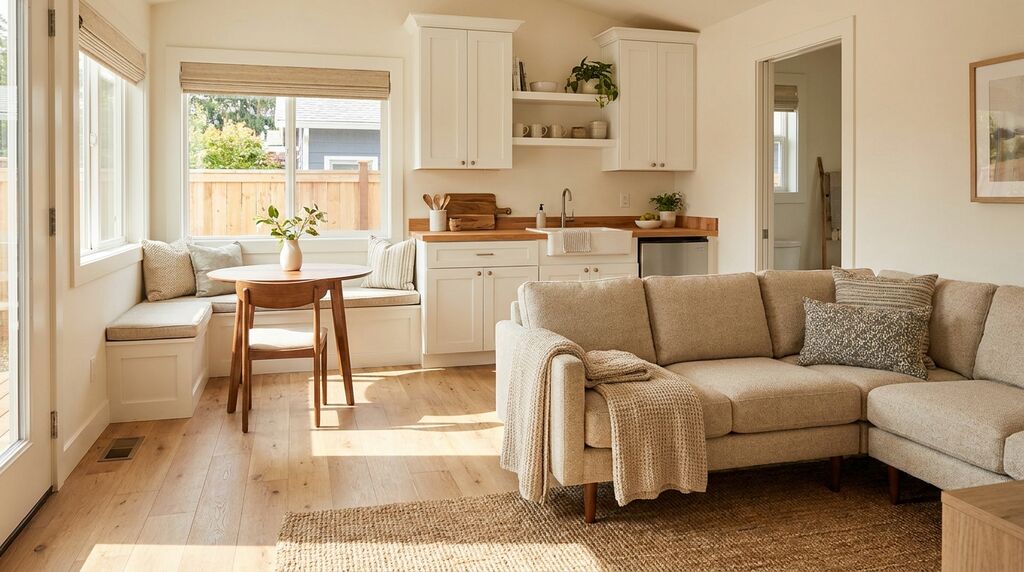
An ADU can pay for itself over time through rental income, reduced need for outside caregiving, or added home value at resale. It is not a guaranteed short-term return. Most homeowners should treat it as a long-term addition to the property, not a flip.
We tell clients to run the math two ways: what a tenant would pay locally, and what it would cost to hire in-home care instead.
Both numbers usually make the ADU look better than it did on paper.
How Long Does It Actually Take to Build an ADU?
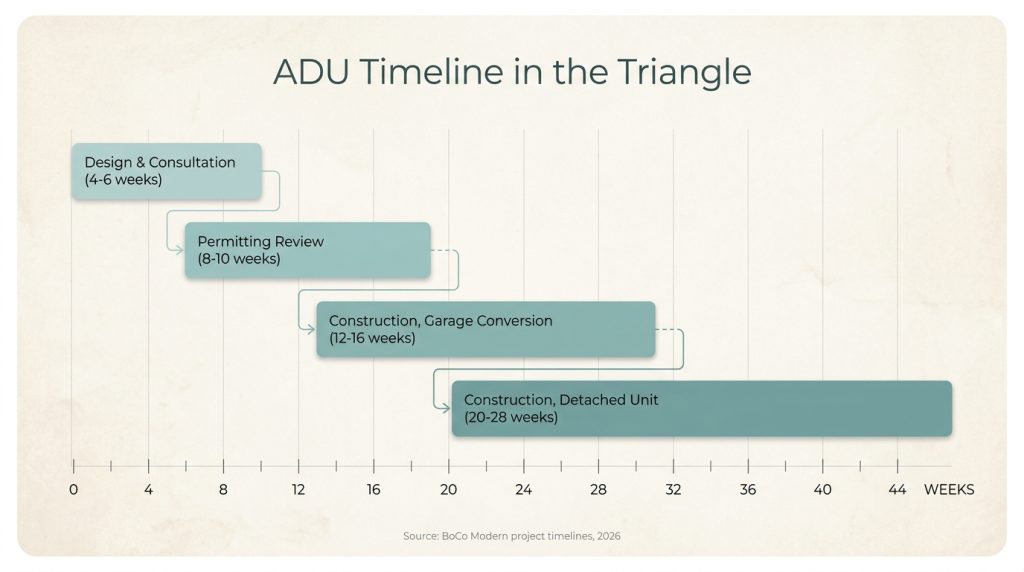
Most Triangle ADU projects take 8 to 14 months from the first design meeting to move-in. Design and permitting typically eat up the first 3 to 5 months, with construction taking another 5 to 9 months depending on type and season.
Garage conversions move fastest since there is no new foundation to inspect.
Detached units on septic or well systems take the longest, mainly because of environmental health review.
Garage Conversion, Attached, or Detached: Which Should You Choose?
The right ADU type depends on your existing garage, your lot’s slope and septic capacity, and how much privacy you want between units. A garage conversion makes sense if you rarely park in it. A detached unit makes sense if you want full separation and have the lot to support it.
A quick way to decide:
- Already have an underused garage? Start there. It is the fastest, cheapest path.
- Need full privacy for a renter or in-law? A detached unit is worth the extra cost.
- Tight or sloped lot? An attached ADU often solves space problems a detached unit cannot.
- Not sure a full second unit fits your property at all? A traditional addition might make more sense.
Not every lot works for a detached ADU. If a traditional addition fits your space better, here is what that project actually costs in Raleigh. Read: Home Addition Raleigh, NC →
What Should You Look for in an ADU Builder?
Look for a design-build firm that gives you a fixed scope and a guaranteed price before construction starts, not just before design starts. Ask specifically how they have handled Raleigh, Durham, or Cary permitting before, since each city reviews ADU applications differently.
What actually matters:
- A single point of contact from design through final inspection
- Local permitting experience with your specific city, not just general contracting experience
- A written, fixed-price contract instead of an open-ended cost-plus agreement
- Willingness to walk your actual lot before giving you a number
Want to see how these decisions play out in a real project? Browse completed additions and ADUs we have built across the Triangle. View Our Additions & ADU Gallery →
How to Get Started on Your ADU Project
Four steps separate a homeowner thinking about an ADU from one holding a permit. None of them require a signed contract to start.
Step 1: Walk Your Lot With a Designer
Before anything else, get a designer on your property to confirm what is actually buildable given your lot’s size, slope, and existing structures. This costs nothing at most Triangle design-build firms and immediately rules out options that look good on paper but do not work on your land.
Step 2: Get a Written, Fixed-Scope Proposal
Ask for a proposal that spells out exact scope and a guaranteed price before you sign anything. A vague scope is how a $180,000 ADU turns into a $240,000 one, and a fixed-price agreement is the only real protection against that.
Step 3: Confirm Your City’s Zoning and Parking Rules
Raleigh, Durham, and Cary each enforce their own ADU ordinances, so confirm your specific city’s size caps, setbacks, and parking requirements before you finalize a design. Skipping this step is the most common reason ADU permits get delayed.
Step 4: Line Up Financing Before Permitting Starts
Talk to your lender about a HELOC, cash-out refinance, or renovation loan before permitting begins, not after. Financing timelines rarely match construction timelines, and starting the loan process early keeps your project moving once permits clear.
Ready to see what an ADU or addition could look like on your lot? Our design-build team walks every Triangle homeowner through site evaluation, budget, and zoning before a single permit gets filed. Explore Additions & ADU Services →
Frequently Asked Questions about ADU Cost
Can I Rent Out My ADU in Raleigh?
Yes, in most cases. The exception is if you build the ADU yourself under North Carolina’s owner-builder exemption. That path legally restricts the unit to non-rental use, and the restriction becomes part of the permanent permit record. Hire a licensed general contractor instead, and renting is generally allowed once the unit passes final inspection.
Do I Need Extra Parking for an ADU in Raleigh?
No. Raleigh does not require additional off-street parking for an ADU, regardless of size or type. This differs from several surrounding municipalities, so if you are comparing Raleigh to Durham or Cary, do not assume the same rule applies. Always confirm parking requirements with your specific city before finalizing a design.
Can I Build Two ADUs on One Property?
In most cases, no. Raleigh generally limits properties to one ADU per lot. An exception exists for certain lots inside frequent transit areas, where two accessory units may be permitted on a single parcel under specific conditions. This is a narrow exception, so confirm eligibility with the city before assuming your lot qualifies.
What Is the Difference Between an ADU and a Home Addition?
An ADU is a separate, self-contained living unit with its own kitchen, bathroom, and entrance. A home addition simply expands your existing living space, like adding a bedroom or enlarging a kitchen, without creating a second independent unit. Home additions are typically simpler to permit and do not carry the same zoning restrictions as ADUs.
Can I Use My Future ADU’s Rental Income to Help Pay for It?
Only in limited situations. FHA’s 203(k) rehabilitation loan allows up to 50 percent of a planned ADU’s projected rental income to count toward loan qualification before construction begins. Most other loan products require the ADU to already exist and have a signed lease before that income can count toward qualifying for financing.
Your ADU, Built Right From the Start
We have walked Triangle homeowners through every version of this project, from a simple garage conversion for an aging parent to a fully detached rental unit. The number that matters most is never the sticker price. It is the number you actually pay once permits, site work, and change orders are done.
A design-build team that prices the whole project up front, and knows Raleigh’s, Durham’s, and Cary’s permitting offices personally, is how you keep those two numbers close together.
Your ADU starts with a conversation, not a contract. Tell us about your lot and your goals, and we will help you figure out what is actually possible. Start Your Project →