

What you need to know now about kitchen remodel cost:
- A standard mid-range kitchen renovation in 2026 typically lands between $27,000 and $35,000, though luxury territory begins the moment you decide to move gas lines or structural walls.
- Cabinets will eat about 30% of your budget, and while I’ve seen homeowners try to cut corners here, cheap hinges and sagging shelves are the fastest way to regret your entire investment within two years.
- You must set aside a non-negotiable 15–20% contingency fund because, frankly, once we pull back the drywall in an older North Carolina home, we usually find a surprise left behind by a previous builder.
- Current market data shows a 73% return on investment for kitchen refreshes, making this the single most effective way to jump-start your home’s equity before the 2027 selling season.
Keep reading to see the exact breakdown of where your money goes and how to stop “budget creep” from ruining your vision.
How Much Does a Kitchen Remodel Cost? The Quick Answer
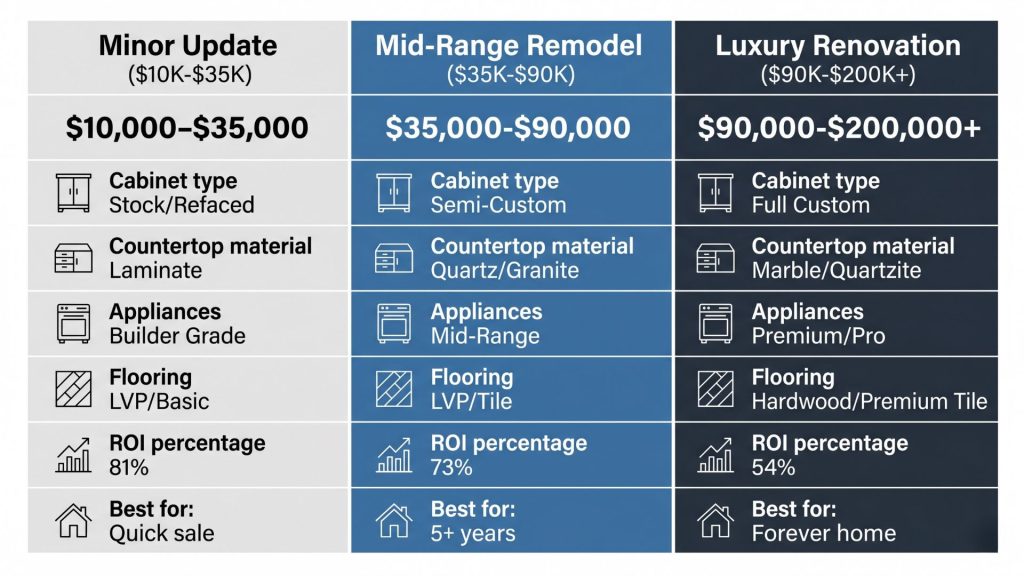
A typical kitchen renovation costs between $27,000 and $30,000 for a mid-range project in 2026, according to the National Kitchen & Bath Association’s 2026 Kitchen Trends Report. That’s the number most design-build firms are seeing for a standard 10×12 kitchen with new cabinets, countertops, appliances, and updated lighting.
For homeowners who want a custom-look kitchen without the full custom timeline or budget, BoCo Modern now offers BoCo Select with curated package designs: pre-selected materials, finishes, and layouts that get you to construction faster. It’s a middle path between off-the-shelf and full custom.
But that’s just the middle of the road. Your actual costs will fall into one of three categories, and which one makes sense depends less on your budget and more on how you plan to use the kitchen.
The 2026 Kitchen Investment Matrix
| Renovation Tier | Total Investment | Lifestyle Impact | Best For | What You Get | What You Give Up |
|---|---|---|---|---|---|
| Minor Update | $10,000–$35,000 | Good for resale | Planning to sell within 3–5 years, or living with an already functional layout | Cabinet refacing, new appliances, updated lighting, fresh paint, new hardware | Custom features, layout changes, high-end finishes |
| Mid-Range Remodel | $35,000–$90,000 | The everyday kitchen upgrade | Staying 5+ years and tired of working around the current layout | New semi-custom cabinets, quartz/granite countertops, quality appliances, new flooring, minor layout adjustments | Luxury brands, major structural changes, professional-grade appliances |
| High-End Renovation | $90,000–$200,000+ | The forever home | Staying 10+ years, cooking is a daily passion, entertaining regularly | Full structural changes, custom cabinetry, premium appliances, luxury finishes (marble/quartzite), architectural details | Nothing. This is the full build. |
Minor kitchen remodels return about 81% at resale, while upscale renovations return closer to 54%. The difference? A minor remodel appeals to everyone. A $150,000 custom kitchen appeals to the specific buyer who wants exactly what you built.
Here’s what that looks like in real numbers:
- Minor kitchen renovation: $10,000–$35,000 for cosmetic updates like cabinet refacing, new appliances, updated lighting, and fresh paint. You’re keeping the existing layout and making surface-level changes. The sink stays where it is. The range doesn’t move. You’re making it look better without changing how it works.
- Mid-range kitchen remodel ($35,000–$90,000): This tier delivers a total transformation with custom cabinetry, stone countertops, and layout changes like adding an island. To get to construction faster, many homeowners opt for our BoCo Select program: a middle path between off-the-shelf and full custom that uses curated design packages and pre-selected materials to streamline the process without sacrificing a high-end look.
- High-end kitchen renovation: $90,000–$200,000+ for full structural changes, premium appliances, custom cabinetry, luxury finishes like marble or quartzite countertops, and possibly moving walls or adding square footage. This is the Wolf range, the Sub-Zero fridge, the custom hood that becomes the centerpiece of the room.
Want to see exactly what your project might cost? Try our free kitchen remodeling calculator. It breaks down costs by scope and helps you prioritize what matters most.
Kitchen Remodel Cost Breakdown: Where Your Money Actually Goes
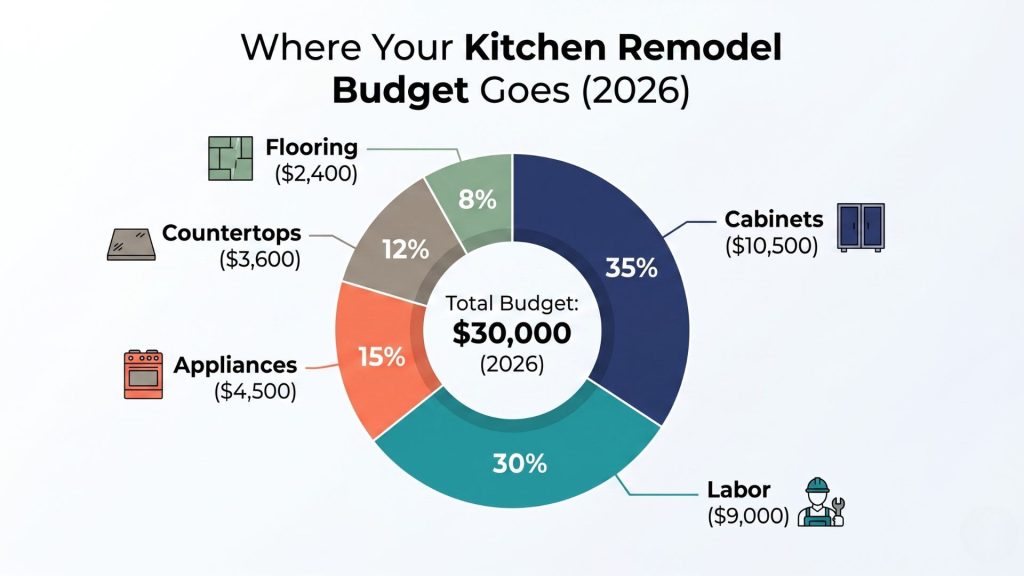
Let’s talk numbers. Here’s what you’re actually paying for in a kitchen renovation, based on current 2026 pricing:
Cabinets (30–40% of Total Budget)
Cabinets are the single largest line item in any kitchen remodel. For a 10×12 kitchen, expect:
- Stock cabinets: $3,000–$8,000 (basic, limited options)
- Semi-custom cabinets: $8,000–$20,000 (more styles, better quality)
- Custom cabinets: $20,000–$50,000+ (built to your exact specs)
The difference isn’t just aesthetic. Custom cabinets use better joinery, have soft-close hardware as standard, and are built to fit your specific space instead of trying to make modular boxes work. If you’re keeping this kitchen for 10+ years, it’s worth it.
Not sure which cabinet style fits your space? Check out our complete guide to choosing kitchen cabinets. We break down when to go custom vs. semi-custom and what actually matters for longevity.
Countertops (10–15% of Total Budget)
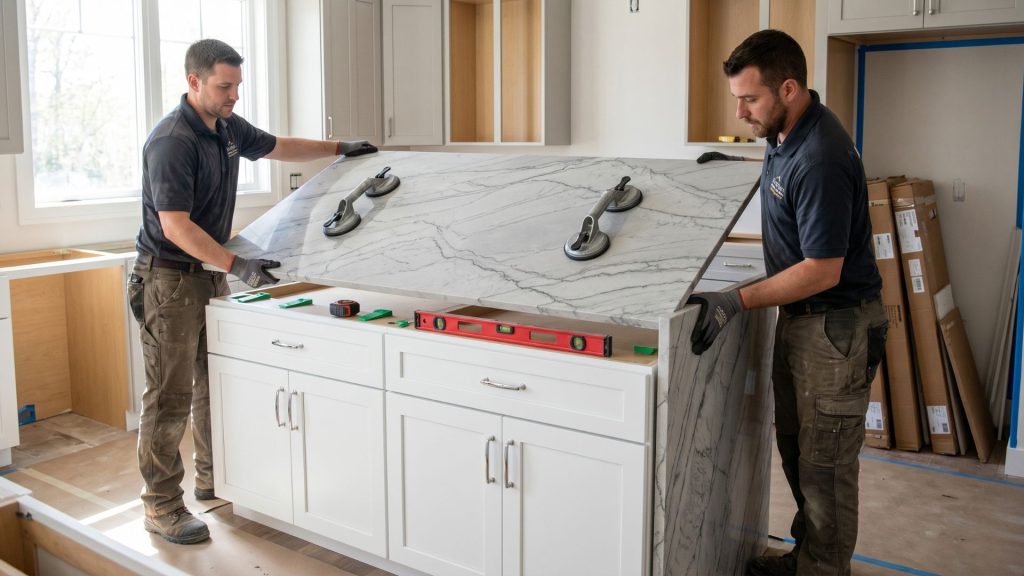
Material choice drives everything here. For a standard 10×12 kitchen with about 30 square feet of countertop:
- Laminate: $1,500–$3,000 (budget-friendly, limited lifespan)
- Quartz: $4,000–$8,000 (engineered stone, non-porous, consistent look)
- Granite: $3,500–$7,000 (natural stone, requires annual sealing)
- Marble or quartzite: $7,000–$15,000+ (luxury natural stone, high-end aesthetic)
Quartz has become the standard for mid-range kitchens. It holds about 60% market share in new kitchen installations. It’s nearly indestructible, doesn’t need sealing, and comes in enough patterns that you won’t feel like you’re settling.
The brands we install most often:
- Cambria (made in the USA, premium pricing),
- Caesarstone (good mid-range option),
- MSI Q-Quartz (budget-friendly without looking cheap).
The difference between a $4,000 quartz job and a $7,000 one usually comes down to the complexity of the edge detail and how many seams you’ll have. A simple eased edge on a straight run of countertop is cheapest. A waterfall edge on an island with an ogee profile costs more because of the fabrication time.
If you’re going granite, budget an extra $150/year for professional resealing or plan to do it yourself with a quality sealer.
Appliances (10–20% of Total Budget)
Appliance costs vary wildly based on brand and features. For a full kitchen package (range, hood, refrigerator, dishwasher, microwave):
- Builder-grade appliances: $3,000–$6,000 (basic Whirlpool, GE, Frigidaire)
- Mid-range appliances: $6,000–$12,000 (KitchenAid, Bosch, Samsung)
- High-end appliances: $12,000–$30,000+ (Wolf, Sub-Zero, Miele, Thermador)
Here’s what I tell every client: don’t mix tiers. If you buy a $10,000 Wolf range but pair it with a $600 dishwasher, the cheap appliance will stand out every time. Either commit to the premium tier across the board or stick with solid mid-range options.
Refrigerators are where I see people make the biggest mistake. Counter-depth fridges (which sit flush with your cabinets) cost 30–40% more than standard-depth models and hold about 20% less food. If you have a large family, that trade-off might not work.
Labor and Installation (20–35% of Total Budget)
Labor typically accounts for about one-third of your total renovation budget. For a $30,000 kitchen remodel, expect $10,000–$12,000 in labor costs.
This includes:
- Demolition and disposal
- Cabinet installation
- Countertop fabrication and installation
- Plumbing and electrical work
- Drywall repair and painting
- Final cleanup
Labor costs in the Raleigh area run about 8–12% below the national average, according to Bureau of Labor Statistics construction wage data for the Research Triangle region. But skilled trades are in high demand. Expect to pay $85–$150 per hour for licensed electricians and plumbers, and $50–$85 per hour for finish carpentry.
Flooring (5–10% of Total Budget)
Kitchen flooring needs to handle spills, traffic, and the occasional dropped pot. Cost per square foot installed:
- Luxury vinyl plank (LVP): $4–$8/sq ft
- Tile: $6–$15/sq ft
- Hardwood: $8–$18/sq ft
For a 150-square-foot kitchen, you’re looking at $600–$2,700 depending on material choice. LVP has gotten good enough that most people can’t tell it’s not hardwood, and it’s completely waterproof. If you’re doing a mid-range remodel, that’s where I’d put my money.
Plumbing and Electrical (8–15% of Total Budget)
Moving plumbing or electrical lines gets expensive fast. If you’re keeping everything in the same spot, budget $2,000–$4,000 for updating fixtures and outlets. If you’re moving the sink, adding a kitchen island with electrical, or relocating appliances, add another $3,000–$8,000.
Structural changes, like moving a gas line for your range or adding a new electrical panel, can push this to $10,000+. That’s why most budget-conscious renovations work within the existing footprint.
Average Kitchen Remodel Cost by Size
Kitchen size has a huge impact on total cost. Here’s what you can expect based on square footage:
Small Kitchen Remodel Cost (Less than 100 sq ft)
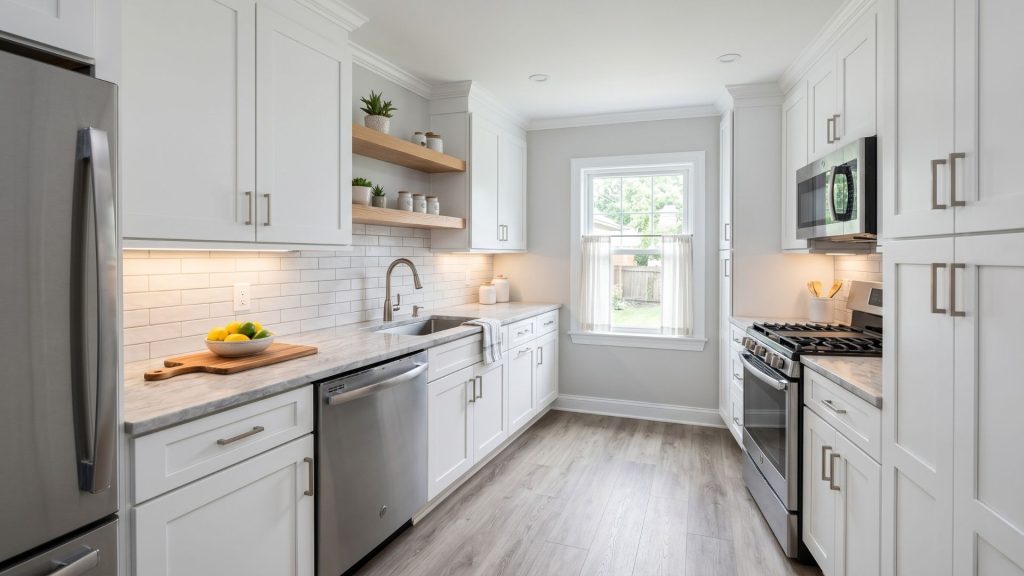
Total cost: $15,000–$35,000
For a small kitchen renovation, focus on:
- Light colors and under-cabinet LED strips to make the space feel larger
- Smart storage solutions like pull-out pantries and corner lazy Susans
- Compact but quality appliances (a 30-inch range instead of 36-inch, a counter-depth fridge)
- One standout element, maybe a tile backsplash or a beautiful faucet, that elevates the whole space
10×10 Kitchen Remodel Cost
Total cost: $20,000–$45,000
The 10×10 kitchen (100 square feet) is the industry standard for cost estimates, about 10–12 linear feet of cabinetry along two walls. Most cabinet manufacturers price their products based on this configuration, which is why you’ll see it referenced constantly when you’re getting quotes.
The other thing that pushes costs in this size range: if your house was built before 1990 and you’re opening walls, there’s a decent chance you’ll find outdated wiring (aluminum or knob-and-tube) or cast iron drain pipes that need replacing. Budget that 15–20% contingency.
12×12 Kitchen Remodel Cost
Total cost: $30,000–$60,000
A 12×12 kitchen (144 square feet) gives you enough space for an island or peninsula, which completely changes how the kitchen functions. Budget an extra $3,000–$8,000 for the island itself, depending on whether it includes seating, storage, or plumbing for a second sink.
Large Kitchen Remodel Cost (200+ sq ft)
Total cost: $50,000–$150,000+
Large kitchens require more materials, more labor, and usually come with higher-end expectations. You’re not just cooking in this space. You’re entertaining, working, and probably spending more time here than any other room in your house.
For larger kitchens, consider:
- Multiple work zones (prep, cooking, cleanup, beverage service)
- Professional-grade appliances that match the scale
- Custom storage solutions: with this much space, there’s no excuse for cluttered countertops
- High-end finishes that match the investment level of the home
What Affects Kitchen Renovation Costs?
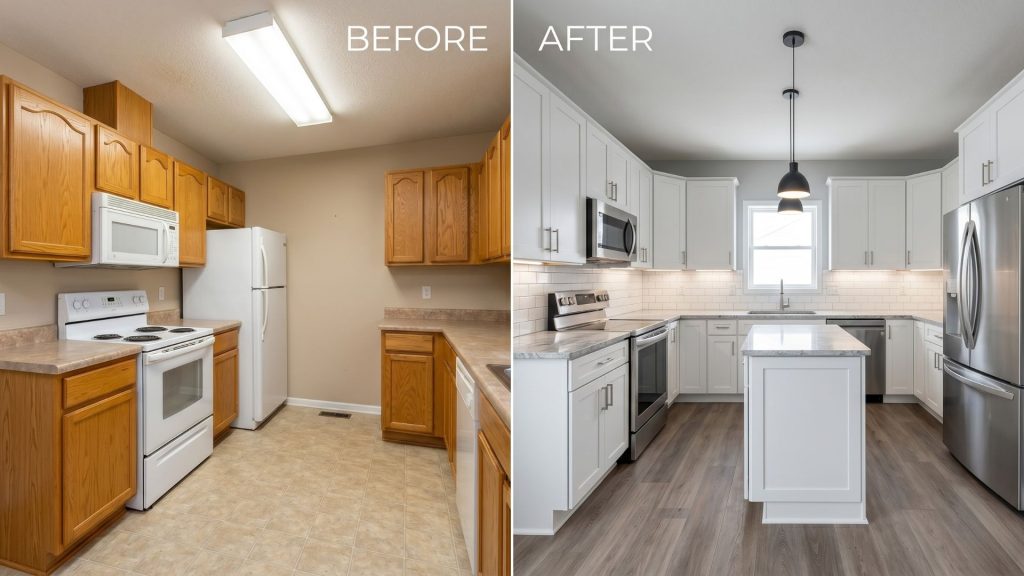
Beyond size and materials, several factors can push your costs up or down. Here’s what moves the needle:
Kitchen Layout Changes
Keeping your existing layout is the cheapest option. The moment you start moving sinks, stoves, or major appliances, costs jump. Why? Plumbing and gas lines are expensive to relocate, and moving them often means opening walls, which means drywall work, which means painting.
Cost impact:
- Same layout, new finishes: Base cost
- Minor layout changes (moving an appliance 2–3 feet): +$2,000–$5,000
- Major layout changes (moving the sink across the room): +$5,000–$12,000
- Adding a kitchen island with plumbing: +$3,000–$8,000
Quality of Materials
There’s cheap, there’s mid-range, and there’s premium. Each tier up roughly doubles your cost.
Cheap materials show wear fast. That $2,000 laminate countertop will have chips and scratches within a few years. The $500 big-box store cabinet will have doors that don’t close right within six months. I’ve seen it happen too many times.
Mid-range materials hit the sweet spot for most renovations. You get durability and decent aesthetics without the premium brand markup. Custom or high-end materials are worth it if you’re staying in your home long-term and want something that looks exceptional.
Structural Changes
Removing walls, adding windows, or changing the ceiling height all require structural engineering, permits, and significantly more labor.
Cost impact:
- Removing a non-load-bearing wall: $1,500–$3,000
- Removing a load-bearing wall: $3,000–$10,000+ (requires structural beam)
- Adding or enlarging windows: $2,000–$5,000 per window
- Vaulting ceiling or adding skylights: $8,000–$20,000+
Most budget-conscious renovations avoid structural work entirely. You can transform a kitchen without moving walls if you nail the design.
Looking for more ideas on how to maximize your kitchen’s potential? Browse our kitchen remodeling trends guide for inspiration that works with your budget.
Labor Costs in Your Area
Labor costs vary significantly by region. According to Remodeling Magazine’s 2026 Cost vs. Value Report, kitchen renovation labor runs 15–20% higher in major metro areas compared to mid-sized cities like Raleigh.
Raleigh sits in a fortunate middle ground, lower than New York or San Francisco, but high enough that you’re getting skilled tradespeople who know what they’re doing. Expect to pay $50–$85 per hour for general contractors, $85–$150 per hour for licensed electricians and plumbers, and $45–$75 per hour for tile installers.
Permits and Design Fees
Most kitchen renovations require at least a building permit, especially if you’re doing electrical or plumbing work. In Raleigh, permits typically run $200–$800 depending on scope.
Design fees vary by firm:
- Online/DIY design: $500–$2,000
- Design consultation: $1,000–$3,000
- Full design-build service: Usually included in project cost
Design-build firms (like us) typically roll design into the overall project cost rather than charging separately. The advantage? Your designer and builder are the same team, which means fewer miscommunications and change orders.
Kitchen Remodel Cost Per Square Foot
Here’s the general range for 2026:
- Budget renovation: $75–$125 per square foot
- Mid-range renovation: $150–$250 per square foot
- High-end renovation: $300–$500+ per square foot
A 150-square-foot kitchen at $200 per square foot would run $30,000 total. But if you’re keeping the same layout and just updating finishes, you might hit the lower end of that range. If you’re moving walls and installing custom everything, you’ll be at the higher end or beyond.
The per-square-foot number is useful for very rough estimates, but don’t base your actual budget on it. Too many variables.
How to Budget for a Kitchen Remodel
Here’s the budgeting framework that actually works:
Set Your Total Budget First
Decide what you’re comfortable spending before you start looking at products. This number should include a 15–20% contingency for surprises. If you can spend $30,000, budget for $25,000 in planned expenses and keep $5,000 in reserve.
Allocate by Priority
Not everything in your kitchen needs to be top-tier. Decide what matters most to you and put your money there. If you care most about cooking and you’re a serious home chef, spend more on appliances and less on decorative elements. If you entertain frequently, invest in the island and seating. Match the budget to how you actually use the space.
Get a Kitchen Renovation Cost Calculator Estimate
Before you talk to contractors, use a kitchen remodel cost calculator to get a ballpark figure. Our free project pricing tool lets you select materials, finishes, and scope to see estimated costs specific to the Raleigh area.
This gives you a reality check before you fall in love with marble countertops and a $15,000 La Cornue range.
Plan for the Unexpected
That 15–20% contingency I mentioned? It’s not optional. Across hundreds of kitchen renovations, I can count on one hand the number of projects that had zero surprises. Budget for it upfront so you’re not scrambling when it happens.
Return on Investment: Is a Kitchen Remodel Worth It?
Kitchen renovations consistently rank among the top home improvements for return on investment (ROI). A mid-range kitchen renovation returns approximately 73% of its cost at resale.
That means a $30,000 kitchen remodel adds roughly $22,000 to your home’s value.
Average ROI by project scope (2026 national data):
- Minor kitchen remodel: 81% ROI
- Mid-range kitchen remodel: 73% ROI
- Major upscale kitchen remodel: 54% ROI
Data from the National Association of Realtors’ 2026 Remodeling Impact Report shows that 75% of homeowners feel a major sense of accomplishment after completing a kitchen renovation, and 54% report increased enjoyment in their home.
Why does ROI drop as you spend more? Because luxury finishes are personal. That $20,000 custom range hood you love might not matter to the next buyer. Mid-range renovations hit the sweet spot, quality materials that appeal to most buyers without over-improving for your neighborhood.
But here’s the thing about ROI: it only matters if you’re selling soon. If you’re staying in your home for 5+ years, the return on investment is how much you enjoy using the kitchen. A well-designed kitchen makes cooking easier, entertaining more enjoyable, and daily life smoother. That’s hard to put a price tag on.
Common Kitchen Renovation Mistakes (and What They Cost)
Here are the expensive mistakes I see homeowners make:
Not Planning for Workflow
The kitchen work triangle (sink, stove, refrigerator) exists for a reason. Ignoring it creates a kitchen that looks great but is frustrating to cook in.
Bad workflow means you’re walking back and forth across the kitchen constantly. It slows down meal prep, makes it harder to cook with a partner, and generally makes your expensive new kitchen less enjoyable to use.
Undersizing the Island
If you’re adding an island, make it functional. A 2-foot-deep island looks like an afterthought. Aim for at least 3–4 feet deep so you can actually use it for prep work and seating.
And make sure you have enough clearance around it: 42 inches minimum for walkways, 48 inches if you want people to be able to pass each other comfortably.
Skimping on Lighting
Overhead lights alone aren’t enough. You need task lighting (under-cabinet LED strips), ambient lighting (recessed or pendant lights), and possibly accent lighting for visual interest.
Budget $1,500–$4,000 for a proper lighting plan. It’s one of the most cost-effective ways to make your kitchen feel expensive.
Not Accounting for Storage Needs
More cabinets aren’t always the answer. Think about what you actually need to store and design around that. Pull-out spice racks, deep drawers for pots and pans, appliance garages to hide the toaster and coffee maker. These specialized storage solutions cost a bit more upfront but make the kitchen way more functional.
Choosing Trendy Over Timeless
That bright blue cabinet color might look amazing on Pinterest right now, but will you still like it in five years? Trendy design choices limit your buyer pool if you sell, and they can make your kitchen feel dated faster.
Stick with classic cabinet styles and neutral colors for the big-ticket items. Add personality with easier-to-change elements like lighting, hardware, and backsplash.
Frequently Asked Questions About Kitchen Remodel Costs
How much should a 10×10 kitchen remodel cost?
A 10×10 kitchen remodel typically costs $20,000–$45,000 depending on materials and finishes. With stock cabinets and basic appliances, you might land near $20,000. With semi-custom cabinets, quartz countertops, and quality appliances, expect $28,000–$35,000. Full custom with premium materials can push past $45,000.
Can I remodel my kitchen for $20,000?
Yes, a $20,000 kitchen remodel is possible for a small to mid-sized kitchen if you stick with stock or semi-custom cabinets, choose mid-range appliances, keep the existing layout, and select budget-friendly countertop materials like quartz or laminate. Expect to compromise on finishes and avoid any structural changes.
How long does a kitchen remodel take?
Most kitchen renovations take 4–8 weeks from demolition to completion. A minor cosmetic update might be done in 2–3 weeks, while a full gut renovation with structural changes can take 10–12 weeks or longer. Timeline depends on scope, contractor availability, and how quickly materials arrive.
What’s the difference between kitchen remodel and kitchen renovation?
The terms are used interchangeably, but technically renovation means restoring something to its previous state, while remodel means changing the structure or layout. In practice, most people use “kitchen remodel” to describe any significant update, from new cabinets and countertops to full layout changes.
Start Your Kitchen Remodel with Confidence
A kitchen renovation is one of the biggest investments you’ll make in your home, but it’s also one of the most rewarding. The right combination of thoughtful design, quality materials, and skilled execution creates a space that works better, looks better, and actually makes daily life more enjoyable.
Whether you’re working with a $20,000 budget or $100,000+, the key is understanding where to put your money, what you can live without, and how to avoid the costly mistakes that derail so many kitchen projects.
Ready to turn your kitchen vision into reality? Schedule a free consultation with our team and let’s talk about what’s possible for your space and budget. We’ll walk through your current kitchen, discuss your goals, and give you a realistic picture of costs and timeline. No pressure, no sales pitch, just honest advice from people who’ve done this hundreds of times.