What you need to know now about kitchen remodel Raleigh, NC:
- A kitchen remodel in Raleigh typically runs $25,000 to $75,000 depending on scope; a minor update can stay under $30,000 and still returns over 100% at resale
- Gray and all-white kitchens are losing ground in 2026 to warm greens, layered neutrals, and wood tones with depth
- The 60-30-10 color rule is the fastest way to build a kitchen palette that holds up over time without looking dated
- Skipping layout changes and focusing on surface upgrades is the single highest-ROI decision in any kitchen remodel
Read on to understand exactly where the money goes, which design calls stand the test of time, and how to avoid the moves that date a kitchen within five years.
Costs shown are general estimates based on national and regional averages, not a quote. Pricing varies by project scope, materials, labor rates, and site conditions. Use these to frame your budget thinking, then get a real number from a contractor.
How Much Does It Cost to Remodel a Kitchen in North Carolina?
A kitchen remodel in North Carolina costs between $15,000 and $100,000 for most homeowners, with the typical full remodel in Raleigh landing in the $35,000 to $65,000 range. Labor rates in the Triangle market run consistently higher than the state average due to sustained demand across Raleigh, Durham, Cary, and Chapel Hill. The table below shows how project type maps to cost range.
Why Does Kitchen Scope Drive Cost More Than Any Other Factor?
The biggest cost variable in any kitchen remodel is not materials. It is whether you move walls, relocate plumbing, or reconfigure the layout. Every one of those decisions multiplies labor.
A few cost drivers that routinely surprise homeowners in Raleigh:
- Layout changes: Moving the sink to a new wall means rerouting supply lines, drain lines, and possibly HVAC. Budget $3,000 to $8,000 for even a modest plumbing relocation.
- Electrical upgrades: Modern kitchens require dedicated circuits for appliances, under-cabinet lighting, and islands. Older homes in Cary, Wake Forest, and Clayton often need panel upgrades to support the load. Add $1,500 to $4,500.
- Structural work: Opening a wall between kitchen and living room requires an engineer’s assessment, a structural beam, and columns or posts. A standard wall removal in this market runs $4,000 to $12,000.
- Appliance disconnects and permits: Wake County requires permits for electrical, plumbing, and gas work. A licensed contractor handles this; a low-bid crew often does not.
How Do Kitchen Project Types Compare on Cost in Raleigh?
| Project Type | Typical Range | What Is Included |
|---|---|---|
| Cosmetic refresh | $12,000 to $28,000 | Cabinet paint or reface, new hardware, countertops, backsplash, lighting, fixtures |
| Mid-range full remodel | $30,000 to $60,000 | New cabinets, countertops, appliances, tile, lighting, plumbing fixtures, permits |
| Major renovation | $60,000 to $100,000 | Custom cabinetry, layout reconfiguration, high-end appliances, structural work |
| Luxury custom remodel | $100,000+ | Full custom millwork, premium stone, integrated appliances, bespoke details |
Want a number for your specific scope before booking a single consultation? Use the BoCo Modern kitchen remodel cost calculator to get a working budget estimate based on your project type.
Is $30,000 Enough for a Kitchen Remodel?
Yes, $30,000 is a workable budget for a kitchen remodel in Raleigh when the scope stays cosmetic: no layout changes, no wall removal, no plumbing relocation. At this budget, you are modernizing the kitchen you have. The line-item breakdown below shows exactly how that money moves.
What Does $30,000 Get You in the Raleigh Market?
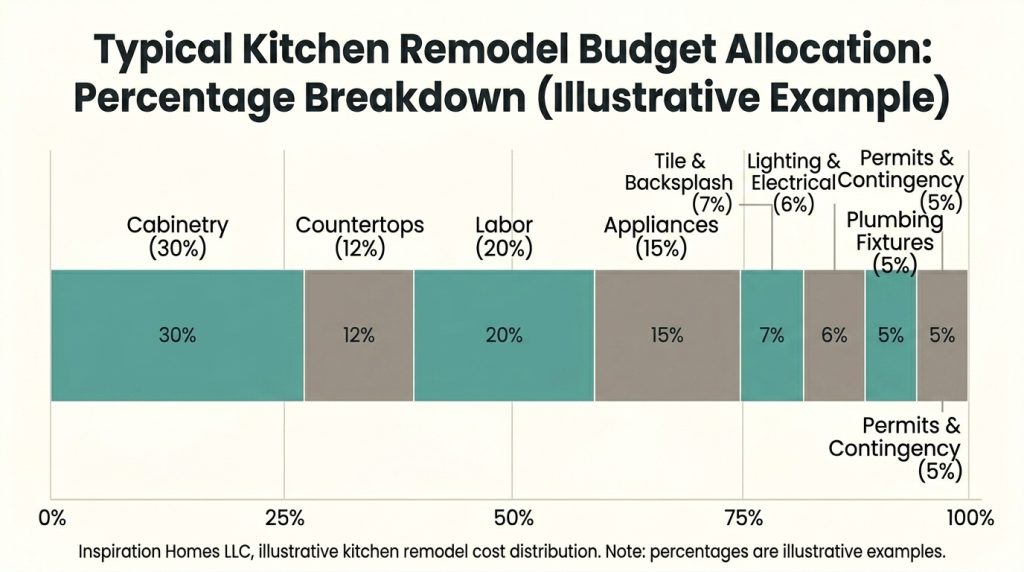
At this budget, priorities matter. Here is how the money typically moves:
- Cabinetry (new semi-custom or full reface): $8,000 to $14,000
- Countertops (quartz, 30 to 40 sq ft): $3,500 to $6,500
- Backsplash tile installed: $1,800 to $3,500
- New fixtures and hardware: $600 to $1,500
- Lighting update (pendants, under-cabinet): $800 to $2,000
- Appliance allowance: $3,000 to $6,000
- Labor, permits, contingency: $5,000 to $8,000
The math is tight but doable if you keep the layout exactly as-is, choose semi-custom rather than custom cabinets, and apply quartz in a standard thickness.
Where Does a $30,000 Budget Fall Short?
- Full appliance suite replacement with premium brands
- Any structural wall removal
- Custom built-in cabinetry or millwork
- Flooring replacement throughout the kitchen and adjacent spaces
- Layout reconfiguration of any kind
Trying to figure out whether a partial remodel or a full replacement makes more sense for your cabinets? The BoCo Modern complete cabinet replacement guide breaks down the cost and decision points in detail.
Can You Redo a Kitchen for $5,000?
A $5,000 budget covers targeted cosmetic updates, not a remodel. At this price in Raleigh, you can repaint cabinets, replace hardware, swap a faucet, update light fixtures, and add a new backsplash in a small kitchen. You cannot replace cabinets, install new countertops, or touch plumbing or electrical. Think of $5,000 as a refresh, not a renovation.
What Can $5,000 Actually Do in a Kitchen?
- Cabinet repainting by a professional: $1,200 to $2,500 depending on cabinet count
- New hardware (pulls, knobs): $200 to $500
- Faucet replacement: $300 to $700 installed
- Light fixture swap (2 to 3 fixtures): $400 to $900
- Peel-and-stick or budget tile backsplash (small kitchen): $400 to $900
Done well, a $5,000 refresh can make a builder-grade kitchen feel meaningfully updated. Done carelessly, it looks like exactly what it is.
The honest context: Raleigh homeowners in Fuquay-Varina, Knightdale, and Garner who want to compete at resale generally need a mid-range budget to achieve a kitchen that photographs well and moves buyers. A $5,000 refresh helps, but it rarely transforms.
What Is the New Look for Kitchens in 2026?
The new look for kitchens in 2026 is warm, layered, and personal. The clinical all-white kitchen with cool gray accents is giving way to kitchens with depth: warm wood tones, earthy greens and blues, natural stone with visible movement, and matte finishes that feel intentional rather than safe. The overriding shift is from kitchens designed to look clean to kitchens designed to feel lived in.
What Are Designers Moving Toward in 2026?
In 2026, designers are specifying warm wood tones, matte finishes, integrated appliances, and natural stone with visible movement. The consistent thread is a move away from surfaces that look clean in a showroom and toward materials that look better with age. Two-tone cabinets with a wood-toned lower and a painted upper are the dominant configuration in active Triangle projects right now.
White oak, walnut, and medium-toned stained wood are appearing in cabinets, open shelving, and islands. This is a direct reaction to a decade of painted cabinetry. House Digest reports that designer consensus for 2026 points to layered greens and blues paired with stained cabinets in rich, medium-toned browns as the palette replacing the gray era.
Wood-toned lower cabinets with painted or plaster upper cabinets is the dominant two-tone approach in active projects across the Triangle market right now.
Is Matte Always Better Than Gloss in 2026?
High-gloss cabinet doors became popular partly because they photograph beautifully. In person, they show fingerprints constantly and read as slightly commercial.
In 2026, matte and satin finishes dominate because they hold up better and look more natural alongside stone and wood.
Are Integrated Appliances Becoming the New Standard?
Appliances that disappear behind cabinet panels are no longer just a luxury kitchen detail. In the $50,000 to $80,000 renovation range, panel-ready refrigerators and dishwashers are becoming the expected finish rather than an upgrade.
Why Is Natural Stone With Movement Trending Again?
Busy marble and dramatic veining are back after years of restrained, subtle slabs. Homeowners who went with a quiet, understated quartz in 2018 are now gravitating toward stone with character.
Waterfall islands in leathered quartzite or dramatic marble are appearing consistently in BoCo Modern projects across Raleigh and Durham.
What Is Outdated in the Kitchen Right Now?
The kitchen details that are aging fastest in 2026 are those tied to the 2015 to 2022 design cycle: all-white cabinetry, cool gray tones, matching stainless appliance suites, and herringbone or chevron backsplash tile.
None of these are failures functionally, but they now read as undifferentiated to buyers and design-aware homeowners.
- All-white everything: The entirely white kitchen with white cabinets, white subway tile, and white quartz is the new builder-grade. It photographs fine but reads as generic.
- Gray cabinets in cool tones: Blue-gray and cool charcoal are fading. Warm charcoals and greens have taken their place.
- Matching stainless steel appliances as a set: The coordinated stainless suite is a 2015 look. Mixed finishes and panel-ready are the current direction.
- Open shelving as the dominant storage: A few open shelves as an accent still work. An entire wall of open shelving looks demanding and cluttered in real use.
- Chevron or herringbone tile backsplash: Once a statement move, now a signal that a kitchen was remodeled in the early 2020s.
- Farmhouse sinks as the central focal point: Still functional, still good. But no longer a differentiating detail in the way it once was.
What Is the 60-30-10 Rule for Kitchens?
The 60-30-10 rule is a color proportion guideline:
- 60% of the kitchen should be a dominant neutral (typically cabinets, walls, and large surfaces),
- 30% a secondary tone (often the island, countertops, or a contrasting cabinet color),
- 10% an accent (hardware, lighting fixtures, tile grout, or accessories).
It gives a kitchen visual structure without looking coordinated to death.
How Do You Apply the 60-30-10 Rule in a Real Kitchen?
Apply the 60-30-10 rule by assigning your largest surfaces (perimeter cabinets, walls, and flooring) to your dominant neutral, your island or countertops to a secondary tone, and your hardware, lighting, and small accessories to an accent. Each zone handles a different job: the 60 grounds the room, the 30 introduces interest, and the 10 delivers personality without visual competition.
This is what covers the most surface area: perimeter cabinet color, wall paint, and flooring. It should feel like the room’s ground, not a statement. Warm off-whites, soft greiges, warm taupes, and medium wood tones are doing this job well in 2026.
If your dominant color is a bold choice, the rest of the room has almost no room to breathe.
What Goes in the 30 Percent Secondary Zone?
Often the island, the countertops, or a contrasting lower cabinet. This is where you can introduce a richer color or a different material without the risk of overcommitting.
A warm green island against off-white perimeter cabinets, or a darker walnut lower cabinet against a lighter upper: both follow this principle.
Where Does the 10 Percent Accent Live?
Hardware, pendant lights, faucet finish, tile grout color, and small accessories. This is where personality shows up. It should feel intentional but not shouty. Matte black hardware, unlacquered brass pendants, or a saturated grout color in a neutral tile can carry an enormous amount of character at low cost.
The 60-30-10 rule is not a rigid formula. It is a way of asking: does my dominant color actually dominate, or is everything fighting for attention equally? If the answer is yes to the second half, the kitchen will feel chaotic regardless of how much individual elements cost.
What Two Colors Do Not Go Well Together in a Kitchen?
The combinations that consistently fail in kitchens are those with clashing temperatures: cool blues or grays paired with warm oranges or terracottas, or stark white paired with bright yellow.
A few pairings designers consistently avoid:
- Cool gray cabinets with warm cherry wood flooring: The temperature clash reads as unintentional
- Bright yellow accents with blue-gray cabinets: High saturation on both creates visual noise
- Stark white walls with natural wood that has orange undertones: The warmth of the wood makes the white feel clinical and harsh
The fix is usually not eliminating one color entirely, but adjusting its temperature. Warm white instead of stark white. Cooler-toned wood instead of orange-leaning oak. Small shifts in temperature resolve most clashes.
Thinking through what a full or partial kitchen remodel would involve for your home? The BoCo Modern kitchen remodeling services page covers the full scope of what a custom kitchen project includes from design through build.
What Color Is Replacing Gray in 2026?
Warm mushroom tones, earthy greens, and layered off-whites are replacing gray as the dominant kitchen palette in 2026. Gray is not disappearing entirely, but the cool, flat, blue-leaning grays that dominated from roughly 2012 to 2022 are giving way to neutrals with warmth and depth. Mushroom, warm putty, and stone tones are the most requested alternatives.
Why Did Gray Lose Its Footing?
Gray became the default kitchen neutral because it read as modern and safe against stainless appliances and white countertops. That combination is now so common it has become the new builder-grade. Buyers seeing a gray kitchen in 2026 do not read it as current; they read it as undifferentiated from every other listing on the market.
Designers are also responding to what people actually want to feel in their kitchen. Gray is technically neutral, but psychologically cool. Warm tones create a different energy in a space used for gathering and cooking.
What Colors Are Winning in 2026?
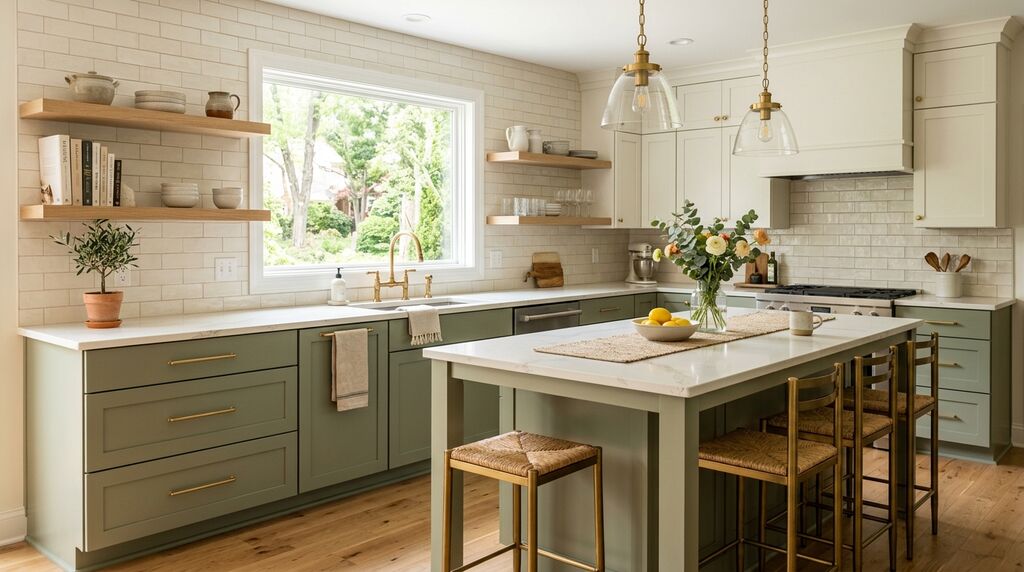
Warm greens, creamy off-whites, and layered neutrals with texture are the clear winners replacing gray in the Raleigh market. The common thread is warmth: colors that reference organic materials rather than design trends tend to hold up longer, which is why sage, warm white, and walnut tones dominate current projects at BoCo Modern across the Triangle.
- Warm whites and off-whites: Creamy whites with yellow undertones (rather than blue) are replacing stark white and cool gray alike
- Layered neutrals with texture: A combination of a plaster-effect wall, a wood-toned lower cabinet, and a stone countertop with visible grain is the direction the market is moving
What Color Kitchen Will Not Date?
The kitchen colors with the longest shelf life are those tied to natural materials rather than paint trends. Warm wood tones, greens with earth undertones, warm whites, and natural stone all age gracefully because they reference organic materials rather than design moments.
Specific choices with strong staying power:
- Warm white cabinetry: Not bright white or cool white. A white that sits closer to cream than to bright
- Sage and forest green: These have been present in traditional and transitional kitchens for decades and show no signs of dating
- Warm wood tones in white oak or walnut: Timeless because they tie the kitchen to materiality rather than color trend
- Greige (gray-beige): The version that leans slightly warm remains durable because it is neither gray nor beige specifically
The colors that date fastest are those that read as distinctly of their moment: the millennial gray of 2014 to 2022, the navy blue island trend of 2019 to 2023. Once a color becomes “the kitchen color right now,” its shelf life is typically under a decade.
Do You Want a Full Renovation Without the Design Waiting Game?
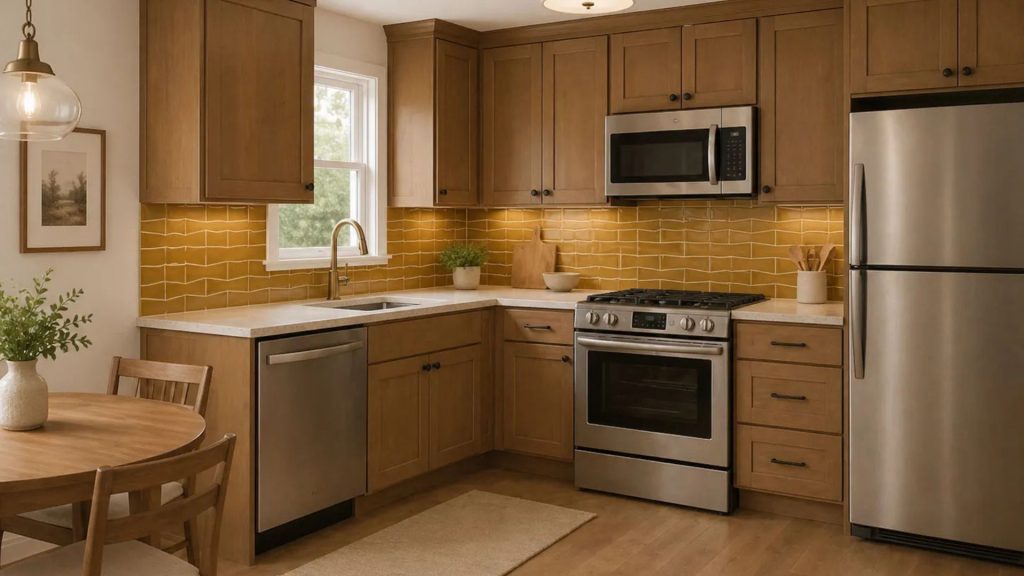
Most kitchen remodels in Raleigh take longer than homeowners expect. The construction itself is rarely the bottleneck. The selection process is. Choosing cabinets, countertops, backsplash tile, lighting, plumbing fixtures, and hardware that actually work together can stretch the planning phase to four or five months before a single wall opens.
BoCo Select Kitchens is a different path.
Each BoCo Select package is a fully coordinated kitchen design, built by BoCo Modern’s in-house design team. The cabinets, countertops, backsplash, floor tile, lighting, and plumbing fixtures are already selected to work together.
These are not entry-level package deals or showroom closeouts. They are the same materials the team specifies in custom projects, sourced from suppliers BoCo Modern works with regularly, and installed with the same crew.
What Makes BoCo Select Kitchens Different?
Every Detail Is Already Designed for You
Every BoCo Select kitchen package is coordinated from the start. You are not choosing from individual components and hoping they relate. The vanity, countertops, backsplash, floor tile, lighting, and plumbing fixtures are already selected to work together before you walk in the door.
The Investment Is Defined Upfront
Each package shows a starting-at price built around a standardized reference kitchen. After a site review, you receive a complete written proposal covering total investment, what is included, and the project schedule. No open-ended estimates or change order ambiguity.
It Moves Faster Than a Custom Design Build
Custom design-build projects can stretch six months or more because every decision is made from scratch. BoCo Select eliminates the selection phase. The design is done. Construction can begin sooner, which means less time living without a functional kitchen.
It is a Full Remodel
Every BoCo Select kitchen is a full remodel. Demolition of the existing kitchen, all-new materials, and BoCo Modern’s standard of workmanship. Nothing from the old kitchen is reused unless the homeowner specifically requests it.
Ready to see what a BoCo Select kitchen looks like and what the investment starts at? Explore BoCo Select Kitchen packages and get a real price without a six-month design process.
Frequently Asked Questions About Kitchen Remodel Raleigh, NC
How long does a kitchen remodel take in Raleigh?
A cosmetic refresh with no structural work typically takes three to five weeks from demo to final walkthrough. A full gut renovation with new cabinets, countertops, and appliances runs six to ten weeks. Any project involving wall removal, plumbing relocation, or structural work adds two to four weeks for permits, inspections, and coordination. The planning and selection phase before construction begins is usually two to six weeks on its own.
Does a kitchen remodel require permits in Wake County?
Yes, for most scopes involving electrical, plumbing, or gas work. Wake County requires permits for adding circuits, relocating plumbing, and any gas appliance connections. A licensed contractor pulls and closes all permits. If a contractor tells you permits are not needed for a scope that clearly involves plumbing or electrical, treat that as a red flag.
Is a kitchen remodel worth it before selling a home in Raleigh?
A focused minor remodel almost always delivers strong returns. According to Fixr’s analysis of the 2025 Cost vs. Value Report, minor kitchen remodels deliver an average 113% ROI nationally, making them the only interior project that routinely returns more than it costs at resale. Full gut renovations with premium finishes return roughly 50% at resale, meaning a significant portion of that investment is personal enjoyment rather than pure asset appreciation.
What is the biggest mistake homeowners make in a kitchen remodel?
Underestimating the cost of layout changes is the most common financial mistake. The second is locking in finishes too late. Every delay in material selection mid-project adds days or weeks to the schedule and increases labor cost because crews are waiting on tile, cabinets, or countertops that are still in transit. Locking down every selection before demolition begins is the single most effective way to keep a kitchen project on schedule and on budget.
Does BoCo Modern serve areas outside of Raleigh?
Yes. BoCo Modern handles kitchen remodels throughout the Triangle, including Durham, Chapel Hill, Cary, Apex, Holly Springs, Garner, Fuquay-Varina, Wake Forest, Knightdale, and Clayton.
What about outdoor kitchens in Raleigh?
Outdoor kitchens are a growing request across the Triangle as homeowners invest in their outdoor living spaces. BoCo Modern handles these as well. See the outdoor kitchen cost guide for Raleigh on the BoCo Modern blog for what outdoor projects run in this market, what is included, and what drives cost up.
Why Do Raleigh Homeowners Choose BoCo Modern for Kitchen Remodels?
Kitchen remodeling is the second most common project among professional remodelers nationwide. According to NAHB’s Q4 2025 survey data, over 50% of professional remodelers rated kitchen remodeling as a common to very common project type.
BoCo Modern operates as a design-build firm. Design and construction are managed under the same contract, by the same team. There is no gap between what gets drawn and what gets built.
The team works across Raleigh and the Triangle with knowledge of local permit requirements, soil conditions, and the housing stock specific to communities like North Hills, Brier Creek, Apex, Cary, and Durham. That local context matters when unexpected conditions arise during demolition.
BoCo Modern works across Raleigh, Durham, Chapel Hill, Cary, Apex, Holly Springs, Garner, Fuquay-Varina, Wake Forest, Knightdale, and Clayton. See the full service area coverage to confirm your neighborhood is covered.
For a deeper breakdown of what a full kitchen remodel includes from cost to timeline, the BoCo Modern kitchen remodel cost guide covers every major line item.
Planning to extend your kitchen outdoors? The BoCo Modern outdoor kitchen cost guide for Raleigh covers what outdoor projects run in this market and what drives the investment.
Ready to talk through your kitchen? Contact BoCo Modern to discuss your goals, your space, and what a realistic project scope looks like for your home.